
Big Bang: a biblical evaluation
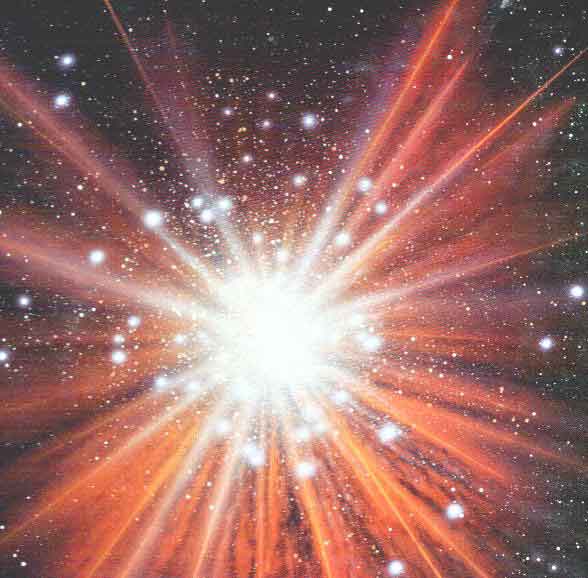


“More than just cosmology is neededto understand the structure and meaning of the Universe”
![bigbang-big-bang-explosion-universe[1]](https://www.veritadellabibbia.it/wp-content/uploads/2015/10/bigbang-big-bang-esplosione-universo1-150x150.jpg) Cosmology deals with the structure and origin of the Universe; the modern one began around 1925, when it was thought to use the largest telescopes of that time to study the most remote bodies in space looking for answers on the structure of the Universe. The observations of the North American astronomer Edwin Hubble (1935) demonstrated that light from almost all galaxies had one “shift towards the red”. The color of the light you received, that is, it was redder than it was when it left the star. A possible explanation for this change is given by the Doppler effect, which occurs when the object emitting light is moving away from the observation point.
Cosmology deals with the structure and origin of the Universe; the modern one began around 1925, when it was thought to use the largest telescopes of that time to study the most remote bodies in space looking for answers on the structure of the Universe. The observations of the North American astronomer Edwin Hubble (1935) demonstrated that light from almost all galaxies had one “shift towards the red”. The color of the light you received, that is, it was redder than it was when it left the star. A possible explanation for this change is given by the Doppler effect, which occurs when the object emitting light is moving away from the observation point.
To interpret your data, Hubble needed a cosmological model of the Universe. There was Milne's and Lemaitre's, both indicating an expanding Universe, in accordance with Einstein's General Theory of Relativity. Zwicky's model, instead, it was more static, therefore it required minor changes to the physics of that time and did not introduce new concepts: it represented, therefore, the framework to which Hubble's observations could best fit. Hubble himself, however, was uncertain about the interpretation to give to his observations and was reluctant to the concept of an expanding Universe, indicated the redshifts as “apparent velocity shifts”.
Shortly after, Hubble partially abandoned his reservations, eventually accepting that the red shift was a Doppler effect: the problem is, he concluded, that most galaxies are moving away from us. In this context the expression of was born “Expanding universe”.
THE EXPANDING UNIVERSE
The next step was simple. It seemed logical that, if today the Universe is expanding, in the past it had to be smaller in size. Going back long enough, the Universe had to have a minimum size, from which it began to expand. It was not surprising that this idea was welcomed by Christians, that they associated this moment with “In the beginning” of Genesis 1:1. It could not be easily established when the beginning had occurred, because it was necessary to consider not only the current speed of expansion, but also its variation in relation to distance. The observed relationship between distance and redshift is called Hubble's law and the parameter that describes the expansion of the Universe is the Hubble parameter, H0. An initial Hubble estimate gave H0 = 500 km/s/kpc, with a consequent age of the Universe of 2 billions of years.
The BIG BANG
The age of the Universe thus calculated caused an immediate problem, because geologists considered the age of the Earth to be around four billion years and it was unthinkable that it, being part of the Universe, could be older than the Universe itself. When more powerful telescopes were built, But, the value of H0 could be determined with greater precision, arriving at an agreement between the geological scale of time and the cosmological one. Around 1960 the situation was much improved, so much so that the generally accepted age of the Universe was approximately 10 billions of years.
Although other theories about the beginning of the Universe have appeared, after that in 1965 important evidence has been discovered, the scientific world has generally accepted the Big Bang theory. It was assumed that the Universe was initially formed by a very hot gas and very dense with elementary particles. In this gas, the light emitted by an internal particle could not reach the outside, because it ended up hitting another particle first, which altered its direction and frequency. If it had been possible to see the primitive Universe from the outside, therefore, we would have seen only the superficial layers: the Universe, that is, it wasn't "transparent".
As a result of the continuous expansion of the Universe, eventually its density would decrease, enough to allow the radiation emitted by a particle to cross almost the entire Universe without encountering another particle: at that moment the Universe would have become "transparent". The Universe would then have 300 thousand years, a very reduced age compared to the total age of approximately 15 billions of years (is equivalent to two hours of a person's life 50 years). Already in the 1940s, Gamow, Alpher and others had calculated that a ray emitted at that time could reach us today without modification and thus inform us about the conditions of the Universe at that time.
A great turning point occurred in 1965 when two engineers, working in the research laboratories of the Bell telephone company, they discovered a strange sound reaching the radio antenna; after analyzing the phenomenon, they concluded that it came from a radiation source that was uniform throughout the sky and had a temperature of just 3 Kelvin gradient (3°K). They immediately deduced that this was the radiation emitted when the Universe became transparent. The discovery offered valid support to the Big Bang theory and convinced many cosmologists of its validity.
This radiation of 3°K, or cosmic microwave radiation (CMR), it seemed to have the same value in all directions; this meant that it originated in different places with the same temperature and density. Which raised a question: in such a uniform medium, how the various structures present in the Universe could have formed, which stars, galaxies, superclusters of galaxies? These structures indicated a non-homogeneity, which must have already existed in the initial stages because, in a completely homogeneous medium, it is impossible to introduce heterogeneous elements without referring to an external influence (diversity cannot arise spontaneously from homogeneity).
Since these first conclusions were reached with observations made from Earth, there was uncertainty due to the passage of radiation through the Earth's atmosphere; plans were then made for the construction of a satellite that could make observations in space, in order to obtain more precise results. In 1990, so, a satellite was launched (COBE) to explore cosmic space and in 1992, examining the collected data, small temperature differences were noticed when looking in different directions. These small fluctuations in temperature and density seemed sufficient to explain the formation of galaxies and other structures. At the end of this journey the Big Bang theory, in its general lines, was accepted by even more cosmologists, through the media, by most people.
It is doubtful whether the Big Bang model would have been received with such interest, if it had simply been a model of the origins of the physical and inanimate Universe. This model, indeed, given that it attempts to explain the origin of the chemical elements found in living beings, it has been linked to the theory of the random evolution of various species. During the first three minutes, when the Universe was very hot and dense, it is thought that only the simplest chemical elements were originated, especially hydrogen and helium; subsequently the temperature would decrease, to the point that the formation of the nuclei of chemical elements (nucleosynthesis) it was no longer possible. Therefore, the question of the origin of the elements important for life (oxygen, nitrogen, carbon, football and many others) has become one of the most interesting in modern cosmology.
THE PROCESS OF NUCLEOSYNTHESIS
After the first ones 300 thousand years, it is believed that gravitational forces have begun to make their influence felt: thus small heterogeneities were formed and grew, attracting the matter present in their proximity. This led to the formation of large clouds, composed mainly of hydrogen and helium. These contracted further and, as a result, there was an increase in temperature in the nuclei. When the core temperature reached i 10 millioni in Kelvin gradient, nuclear processes began. Hydrogen began to be transformed into helium with the production of a lot of energy, which became visible in the form of radiation: thus the stars were born, which shine due to nuclear reactions that take place within them. Even in very large stars the amount of nuclear fuel (hydrogen) it is not unlimited and, when a large part of it has been consumed, the star's core collapses, causing the temperature to increase to approx 25 millioni in Kelvin gradient. At this temperature helium, which had remained inert until then, it becomes fuel and turns into carbon.
These processes of nucleosynthesis are supposed to have been repeated several times, second cycles of shorter duration, and would have led to the formation of the various chemical elements, including iron. What you think happened next depends on the mass of the stars. If a star had enough mass, exploded as a supernova, producing many elements heavier than iron in a short time. In exploding, a large amount of the star was scattered into space, generating large clouds from which another generation of stars could form. finally, and most likely in multiple places, planets composed of solid mass were formed, including the Earth itself. At this point it is believed that the processes of natural evolution gave rise to the spontaneous generation of life, which then generated intelligent living beings.
There are many aspects of the Big Bang model with which Christians can agree: the primitive Universe was dominated by radiation and light, to remind us of what happened on the first day of the week of creation; Adam was born with material (the dust) existing on Earth; the Sun, the Moon and stars were created on the fourth day, that is, when something already existed. However, there are also many discrepancies between the Big Bang and Genesis, for example: and receive 300 thousand years, when the Universe filled with light, they cannot be compared with the first day of Genesis; the life, according to the Big Bang approach it is not created by God, but it arises from inanimate matter; according to the Big Bang theory it took much longer than the biblical six days to complete the process; let's leave aside other disagreements.
SCIENTIFIC AND PHILOSOPHICAL PROBLEMS
Apart from the differences between Big Bang cosmology and Genesis, There are scientific and philosophical problems within the Big Bang model, which we will now look at briefly.
SCIENTIFIC PROBLEMS
Other interpretations of “shift towards the red”. The cause of the red shift is not necessarily the moving away of galaxies: there are other phenomena that can cause it. Among these is the so-called “gravitational red shift”, which implies incredibly large masses for very distant galaxies. Then there is the so-called "transverse Doppler effect", which implies a very rapid revolution around a center: Ellen White wrote about “suns, stars and planetary systems, all in established order, which revolve around the throne of the Divinity" and we must admit that the revolution around a center is a general characteristic of cosmic bodies. Finally, a theory states that, by interaction with matter, light loses some of its energy (thus moving towards the red) on the long journey from a galaxy to Earth. This “tired light” theory, in my opinion, it has never received the attention it deserves.
The question of antimatter. In the Big Bang theory the elementary particles, which electrons, protons, neutrinos, neutrons and others, they are believed to have been produced at the beginning of the Universe. Laboratory experiments and best observations, But, they show that these elementary particles are associated with the corresponding antiparticle formed by antimatter: positron antiparticles, for example, are produced together with electrons, antiprotons with protons, etc.. When a particle meets its antiparticle, the two disappear in a flash of energy. In the very dense Universe, after the particles and antiparticles were formed, it would have been inevitable that all particles had found their antiparticle. As a result, the Universe should be composed of radiation and devoid of matter (except particles like neutrons, which have no antiparticles). Instead, we note a strong presence of normal matter in the Universe, therefore we must assume some asymmetry in the production of elementary particles (with more normal particles than “anti”), otherwise half the Universe would have to consist of antimatter, rigorously isolated from normal matter. However, there are no indications to support a possible asymmetry and no large quantity of antimatter has been identified .
PHILOSOPHICAL PROBLEMS
a) IS “eternal” the matter or Dio? Even though it was not possible to directly observe the Universe in the early days 300 thousand years of its existence, we can deduce its conditions at that time starting from the CMR: assuming the expansion occurred even before that time, we can extrapolate the various data backwards. Regressing over time according to this logic, we would find the Universe progressively denser and hotter so that in order to explain what was happening we would have to apply principles of physics that were less and less comprehensible each time. Arrived at a certain point in time, the Universe would have been so dense and hot that, even using the most advanced knowledge of theoretical physics, it is not possible to analyze those extreme conditions. It is estimated that such a situation would soon arise 10 seconds from the zero point, which is considered the beginning of time and space. The incomprehensible conditions of the Universe during this first fraction of seconds are called a “singularity”. Some might think that such a short time may be negligible and that we have therefore triumphantly arrived at the beginning of everything; but the problem is that, in a range of 10 seconds, the Universe must have already possessed a lot of matter and we cannot explain this situation. Some claim that this "primordial" matter is the result of an earlier phase of the Universe when, after another previous expansion, had suffered a collapse. One can thus invoke a Universe that goes through repeated cycles of expansion and contractions: our, according to this scheme, it would simply represent the current version of a cyclical process. This so-called “Oscillating Universe” does not really answer the question of its origin. Claiming that there has always been a Universe is devoid of scientific meaning, or identify the Universe “eternal” with the eternal God of the Bible: none of these answers are acceptable to a Christian. Others, being more honest, they remind us that it is possible to create matter starting from energy, but it's obvious to ask: «Where did this energy come from??». In my opinion, it comes from a powerful God and I believe it is the only real answer.
b) Crucial unprovable assumptions. The development of the “Big Bang theory” during the last 70 years is full of assumptions which, according to the rules of purely scientific reasoning, they do not have to be part of the scientific process: we mention some of them.
The expansion of the Universe is based on a biased philosophy. In the interpretation of the red shift, Hubble adopted the validity of the General Theory of Relativity (not a bad choice) and of the Cosmological Principle (stating that the Universe looks the same from any observation point). Although the latter seems to be a reasonable hypothesis (in fact the only one that can be done constructively) its validity cannot currently be confirmed (and perhaps it never can be).
The “Big Bang theory” is based on the assumption that science can explain everything, who can answer all questions. This is a baseless assumption and, those who believe in God, they know all the more that it is not correct. Science cannot explain the origin of love and hate, of joy and sadness, of truth, beauty, consciousness and many other human characteristics.
Various alternative theories have been rejected, many times without adequate consideration of their proposals. Calls “non-scientific theories”, “theories that contain elements of philosophy or religion”, were rejected without the slightest consideration. By assuming this attitude, cosmology condemned itself, because it too has adopted philosophical and not scientific assumptions. Worse still, cosmology has closed its eyes to what could well be an essential part of reality and the Universe.
All this according to an unexpressed dogma, but well known of cosmology, according to which the God of the Bible and Calvary does not exist and any God we believe in is a fruit of our imagination.
CONCLUSION
Based on the above, we must conclude that modern cosmology, represented by the Big Bang theory, may have its validity in explaining numerous aspects of the inanimate physical Universe, but it turns out to be a weak theory when it tries to explain everything, leaving many questions unanswered. As Robert Jastrow concluded in his book “God and the Astronomers”: «At this moment it seems that science cannot dissolve the cloud that surrounds the mystery of creation. For the scientist who lived by trusting in the power of reason, the story ends like a nightmare. He has climbed the mountains of ignorance; has reached the point of conquering the highest peak and finally, in reaching the final peak, is greeted by a group of theologians who have been sitting there for centuries".
It's possible, then, harmonize modern cosmology with the Bible? You should try to do so? If so, how it can be done? Despite the latest critical considerations, allow me to say that I admire the scientific method and commitment. We have learned many things about nature that can help us live more comfortably. Beyond this, science is one of the methods that God uses to communicate himself and the plans he has for us. «The heavens declare the glory of God» (Salmo 19:1), but there are at least two problems with this means of knowledge: 1) sin ruined God's work, which now reflects the character of the Creator only in a dim way; 2) what God wishes to reveal to us through nature we perceive incompletely, and sometimes distorted, due to our limited intellectual and moral capabilities. Let's not forget, But, that we cannot return to the ivory tower of theology, explaining everything around us with the Bible alone.
To conclude, it is precisely because of our incomplete understanding, both of nature and of God's law, which many times we believe contradict each other. But God is the creator of both and there can be no conflict if everything is interpreted correctly. We need the Word of God and science, to make sense of the Universe where we live.
Albert Einstein said: «Religion without science is blind; and science without religion is lame", but it is difficult to know exactly how to blend the discoveries of science with our view of the Bible, in an attempt to provide answers to the problem of origins. I believe that God created the Universe: “In the beginning” may mean that He began His work of creation long ago. Cosmology, if well understood, teaches how God began the work of preparing a planet that had chemical characteristics to form humans and keep them alive. This was how God crowned his work of creation. In six days He prepared the Earth to be inhabited, he created many living beings and the human being, to which he assigned a special position.
The rest of the Bible tells us what happened next and how, in spite of our rebellion, God's magnificent plan will finally be fulfilled for those who accept the redemption offered through Jesus Christ. The fulfillment of this plan includes the opportunity to know the truth about the Universe and I would gladly change my opinion only if the Creator told me He did it differently..
of Martin De Groot
Mart de Groot obtained his doctorate in Astronomy from Utrecht University (Netherlands), He is a research associate at the Armagh Observatory, in Northern Ireland.
The subject is taken from a paper given at the "First International Meeting of Creationists" held in S. Paul of Brazil, from the 21 al 24 January 1999, at the Adventist Teaching Institute.
